Imagine leaving the front door of a high-security facility wide open, relying entirely on a motion detector to text you if an intruder walks in. By the time you get the notification, read it, and drive over to lock the door, the vault is already empty. This is exactly what happens when enterprise networks rely on passive monitoring alone in an era where cyberattacks happen at machine speed.
To survive today’s hyper-connected, AI-driven threat landscape, organizations must deploy a dynamic, multi-layered defense strategy. At the very center of this defense is the implementation of an IDS/IPS (Intrusion Detection/Prevention Systems) framework.
As digital perimeters dissolve into distributed multi-cloud architectures, understanding how these monitoring technologies inspect data packets, analyze malicious behaviors, and actively mitigate risks is no longer just a compliance checkbox. It is a fundamental requirement for operational resilience.
The Core Architecture: Understanding IDS vs. IPS
While often grouped together as a single acronym, an intrusion detection system and an intrusion prevention system serve entirely different operational roles within a network architecture. The fundamental distinction lies in their placement relative to the data flow and their power to intervene during an active exploit attempt.
An Intrusion Detection System (IDS) monitors network or system activity for suspicious behavior and alerts administrators when potential threats are detected. It serves as a watchful observer, continuously analyzing traffic and system events.
An Intrusion Prevention System (IPS) performs the same monitoring function but goes one step further by automatically blocking or preventing malicious activity in real time.
Think of it this way:
- IDS is like a security camera that alerts you when someone enters a restricted area.
- IPS is like a security guard who not only notices the intruder but also stops them immediately.
Both technologies work together to strengthen an organization’s overall cybersecurity posture.
Intrusion Detection Systems: The Digital Security Camera
An Intrusion Detection System operates as a passive monitoring mechanism. It is typically deployed out-of-band, meaning it does not sit directly in the path of live network traffic. Instead, network switches use port mirroring or a test access point to send a mirrored duplicate copy of the traffic to the system.
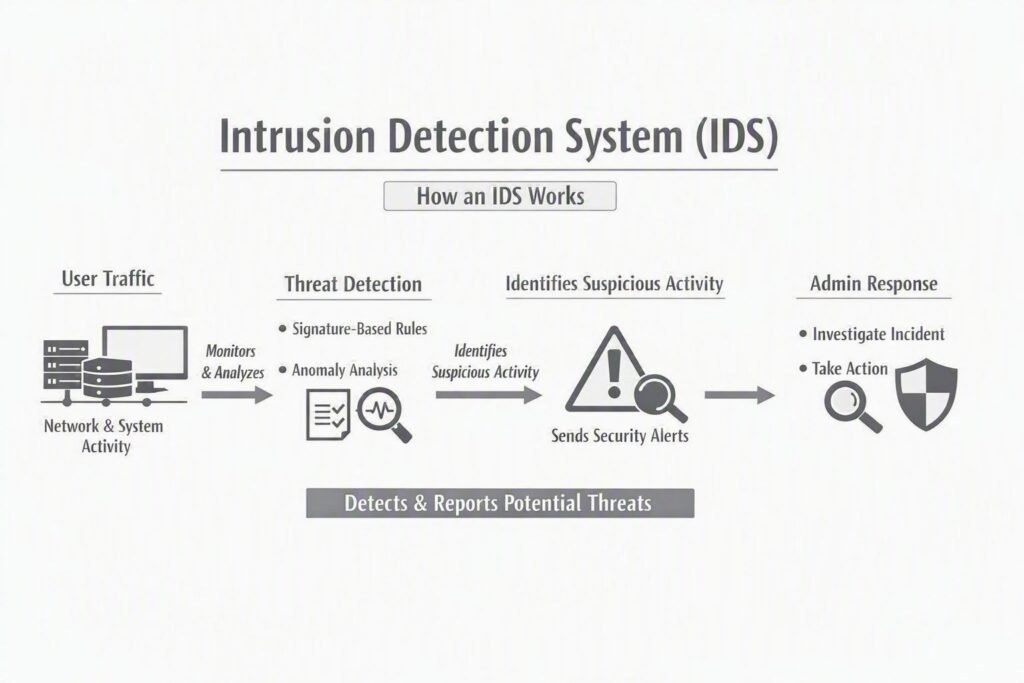
When a suspicious packet pattern or known vulnerability exploit is identified, the system logs the incident and generates an alert for the Security Operations Center. Because it only evaluates copies of packets, a standalone network detection tool cannot stop an attack from completing its objective. It simply records the event and notifies human analysts.
Intrusion Prevention Systems: The Automated Guard
An Intrusion Prevention System is an active, inline security mechanism. Every single data packet traveling into or across the network segment must physically pass through the appliance before reaching its final destination.
This inline positioning gives the system the unique capability to take real-time preventive actions. If a packet matches a malicious signature or violates an established behavior protocol, the system can instantly drop the packet, reconfigure connected firewall rules to block the originating IP address, or completely isolate the affected network segment.
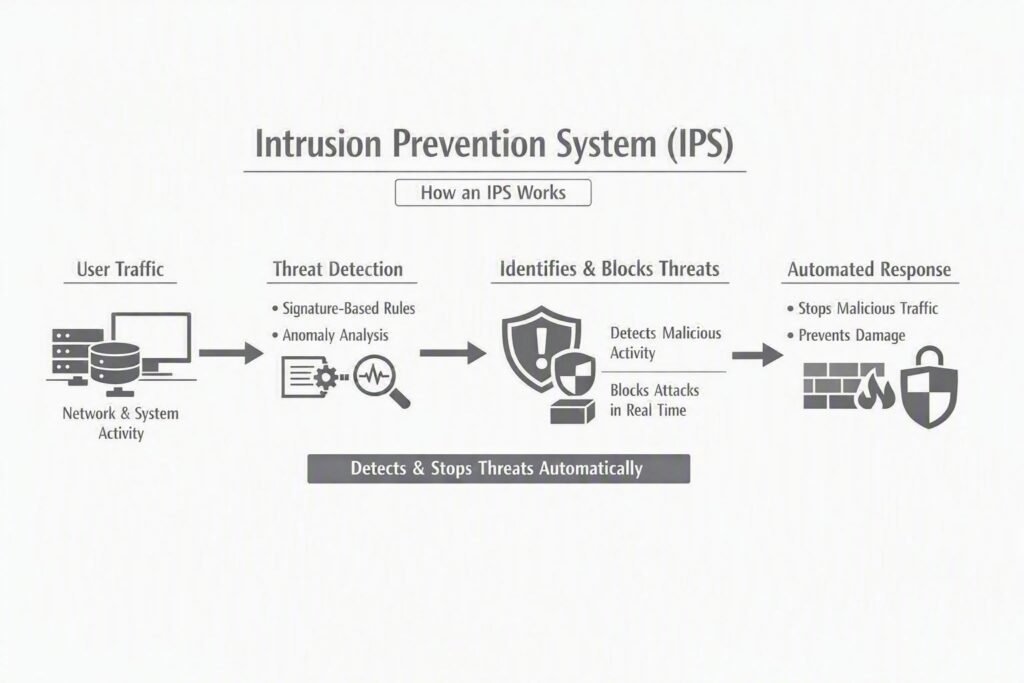
As illustrated in the deployment diagram above, the operational difference changes how traffic moves through your infrastructure. On the left, the detection system watches a duplicate stream of data from the switch, ensuring that even if the system fails or experiences high utilization, production traffic remains completely unhindered.
On the right, the prevention system sits as a gatekeeper directly between the firewall and the internal network switch. This inline posture means that if a threat is detected, it is immediately terminated before entering the corporate local area network, though it introduces a slight processing latency to every packet.
Head-to-Head Comparison: IDS vs. IPS
To help guide infrastructure design choices, the table below highlights the technical differences, resource costs, and strategic tradeoffs encountered when managing these security layers.
| Architectural Feature | Intrusion Detection Systems (IDS) | Intrusion Prevention Systems (IPS) |
| Network Position | Out-of-band (uses mirrored traffic or taps) | Inline (directly in the primary traffic path) |
| Primary Action | Passive monitoring, logging, and alerting | Active blocking, dropping packets, and resetting sessions |
| Network Latency | Zero impact on live traffic speeds | Minimally increases packet processing latency |
| System Failure Risk | Safe; traffic flows normally if the appliance crashes | High risk; can drop legitimate traffic if misconfigured |
| Operational Focus | Historical forensics, visibility, and compliance | Real-time threat mitigation and attack surface reduction |
| Key Open Source Tools | Basic deployments of passive network analyzers | Advanced configurations of inline multi-threaded engines |
How Detection Methods Have Evolved
Modern systems no longer rely on simple, rigid pattern matching. As hackers have learned to obfuscate payloads and use polymorphic malware, the underlying engines powering an IDS/IPS (Intrusion Detection/Prevention Systems) deployment have shifted toward a hybrid, multi-layered analysis pipeline.
Signature-Based Detection
This traditional method operates like antivirus software, comparing incoming network packets against a vast localized database of known attack footprints, specific byte sequences, and historical vulnerability exploits.
It is incredibly accurate and computationally efficient for identifying established threats, such as a known ransomware payload or a specific remote code execution string. However, signature-based engines have a critical vulnerability: they are completely blind to zero-day attacks and novel variants that have not yet been cataloged by security researchers.
Anomaly-Based Detection
To solve the zero-day blind spot, anomaly-based engines establish a statistical baseline of what normal network behavior looks like over a dedicated learning period. This baseline tracks metrics like typical bandwidth utilization, protocol usage patterns, and standard device communication hours.
If a device suddenly initiates hundreds of concurrent connections using an unusual protocol, the system flags it as an anomaly. While highly effective at exposing brand-new exploit methods, anomaly-based systems are notorious for generating high volumes of false positives when legitimate business operations occasionally shift.
Behavioral Analysis and Machine Learning
The modern frontier of network protection integrates machine learning models to look at contextual intent rather than static rules. Instead of flagging a single unusual action, behavioral systems analyze the entire lifecycle of an event.
For instance, if a user account logs in from an unusual geographic location, immediately runs a series of Active Directory queries, and then attempts to download an encrypted file share, a behavioral engine links these actions together. This allows security teams to identify advanced persistent threats executing slow, low-profile lateral movements across an enterprise network.
The Encryption Blind Spot: With a massive majority of global web traffic protected by transport layer security encryption, traditional deep packet inspection is frequently blinded. Modern engines combat this by using encrypted traffic analytics, analyzing unencrypted packet headers, packet sizes, and transmission timing sequences to identify malware without needing full decryption.
The Modern Frontier: Cloud-Native and Kernel-Level Security
As companies migrate workloads out of bare-metal data centers and into containerized microservice environments, the traditional concept of an appliance-based security perimeter breaks down.
In a cloud-native ecosystem, internal east-west traffic moving between microservices on the exact same virtual machine host never passes through a physical network switch or a legacy firewall. This creates massive visibility blind spots where a single compromised container can easily infect an entire cluster.
To close these gaps, modern security frameworks leverage extended Berkeley Packet Filter technology. By running highly optimized sandboxed programs directly inside the operating system kernel, open-source networking platforms allow teams to achieve identity-aware, high-performance visibility.
This kernel-level approach completely avoids the massive performance overhead caused by traditional userspace context switching, letting platforms analyze system calls, network flows, and file changes at line speed.
Furthermore, major cloud service providers have developed built-in cloud-native intrusion detection services. These managed solutions seamlessly mirror virtual network traffic into specialized analysis engines powered by cloud-scale threat intelligence networks, ensuring that scaling up your infrastructure does not require a complex overhaul of physical network architecture.
The Major Types of IDS/IPS Solutions
NIST identifies several key categories of intrusion detection and prevention technologies.
Network-Based IDS/IPS (NIDS/NIPS)
These systems monitor traffic moving across network segments.
Common uses include:
- Detecting malware
- Identifying scanning attempts
- Monitoring lateral movement
- Blocking known attack signatures
They’re especially effective at protecting network perimeters and internal communication channels.
Host-Based IDS/IPS (HIDS/HIPS)
Host-based solutions operate directly on endpoints such as:
- Servers
- Laptops
- Workstations
- Virtual machines
They monitor:
- File integrity changes
- System logs
- Application activity
- User behaviors
Because they’re installed on the endpoint itself, they can detect attacks that network sensors might miss.
Wireless IDS/IPS
Wireless-focused solutions monitor Wi-Fi environments for:
- Rogue access points
- Unauthorized devices
- Wireless attacks
- Misconfigurations
These tools are particularly useful in large corporate environments with extensive wireless infrastructure.
Network Behavior Analysis (NBA)
Rather than looking only for known attack signatures, these systems analyze traffic patterns and behavior.
This approach helps identify:
- Insider threats
- Data exfiltration
- Botnet communications
- Unusual network activity
As threats become more sophisticated, behavioral analysis has become increasingly valuable.
Common Challenges and Misconceptions
While IDS/IPS are powerful tools, they are not perfect.
False Positives
One of the biggest operational challenges is excessive alert volume.
Poorly tuned systems can generate thousands of alerts, many of which may be harmless.
The solution is ongoing tuning and rule optimization.
Encryption Limits Visibility
Increasingly, traffic is encrypted.
Some IDS/IPS tools may struggle to inspect encrypted communications without additional technologies or integrations.
They Are Not Complete Security Solutions
A common misconception is that installing an IDS or IPS automatically makes an environment secure.
In reality, these systems work best when combined with:
- Endpoint protection
- Security information and event management (SIEM)
- Threat intelligence
- Identity security
- Security awareness training
Security is a layered strategy—not a single product.
Practical Implementation Pitfalls to Avoid
Transitioning from a passive detection posture to an active, inline prevention posture requires precise engineering. If deployed carelessly, an automated prevention system can easily become the single biggest source of self-inflicted network downtime in your organization.
The Danger of Alert Fatigue
One of the most frequent mistakes security operations teams make is activating an enterprise threat prevention platform with every single out-of-the-box signature rule enabled from day one.
This results in an overwhelming cascade of thousands of daily low-priority alerts, causing security analysts to suffer from profound alert fatigue. When critical, high-severity indicators of compromise are buried beneath thousands of false positives generated by harmless web traffic, the entire security infrastructure fails its core mission.
A Safe, Phased Deployment Strategy
To implement an IDS/IPS (Intrusion Detection/Prevention Systems) architecture without interrupting legitimate business operations, organizations should adhere to a strict, phased deployment pipeline:
- Phase 1: Out-of-Band Auditing: Deploy the system in detection-only mode using a network tap to establish traffic baselines and measure hardware resource consumption.
- Phase 2: Active Rule Tuning: Spend several weeks auditing generated alerts, creating custom exclusion rules for internal software, and disabling signatures that are irrelevant to your specific operating systems.
- Phase 3: Inline Detection: Move the appliance into the physical inline path, but keep its policy configuration set strictly to log threats without actively dropping packets.
- Phase 4: Targeted Prevention: Gradually convert highly accurate, severe signature categories into block actions, starting with proven remote code execution and ransomware indicators.
The Verdict: Building a Resilient Defense
Network security is no longer about building an impenetrable wall; it is about establishing comprehensive visibility and executing rapid, automated responses.
An optimization strategy that relies purely on firewalls will miss internal lateral movements and complex application-layer exploits. Conversely, an enterprise that relies solely on endpoint agents will remain blind to unmanaged IoT hardware, legacy printers, and smart building systems that lack agent support.
IDS/IPS (Intrusion Detection/Prevention Systems) remain among the most important security controls available today. They provide visibility into suspicious activity, help security teams respond faster, and in many cases stop attacks before serious damage occurs.
While modern cybersecurity has expanded far beyond traditional network defense, the fundamental challenge remains the same: detecting malicious behavior quickly and acting before attackers succeed.
That’s exactly what IDS and IPS were designed to do.
Whether you’re securing a small business network or protecting a global enterprise, investing in a well-designed IDS/IPS strategy can dramatically improve your security posture and resilience against evolving cyber threats.
Pingback: Roadmap to the Cybersecurity world - The Cyber Server