Imagine receiving millions of security-related events every day from firewalls, servers, cloud platforms, applications, and endpoints. Hidden somewhere in that flood of data could be the first indicator of a ransomware attack, insider threat, or compromised account.
This is where SIEM Operations (Log Aggregation and Analysis) becomes indispensable.
Security teams no longer struggle because they lack data. They struggle because they have too much of it. The challenge is converting thousands of disconnected logs into meaningful insights that help analysts identify threats quickly and accurately.
According to Microsoft’s overview of SIEM, modern Security Information and Event Management platforms collect, aggregate, and analyze security data from across an organization’s environment to support real-time threat detection and incident response.
For a mid-sized enterprise, this storm translates to millions of events per second. For global corporations, it scales into the billions.
How do security teams keep their heads above water? The answer lies in the engine room of the modern Security Operations Center (SOC): SIEM Operations (Log Aggregation and Analysis).
If you are a security leader, a SOC engineer, or an IT professional tasked with turning chaotic raw data into a proactive shield, this guide is for you. Let’s lift the hood on how this crucial operation actually works and explore the real-world strategies that separate successful security programs from expensive data dumps.
The Core Blueprint: What is SIEM?
At its most fundamental level, Security Information and Event Management (SIEM) is a cybersecurity architecture designed to act as the central nervous system of your IT environment. Historically, SIEM emerged from the consolidation of two distinct concepts:
- Security Information Management (SIM): The process of gathering, storing, and reporting on log data for compliance, long-term retention, and historical analysis.
- Security Event Management (SEM): The real-time monitoring, correlation, and analysis of events to generate immediate security alerts.
Modern security teams no longer treat these as separate disciplines. A robust enterprise monitoring strategy relies on a unified platform where long-term historical context directly feeds into real-time threat detection.
What Is SIEM Operations?
SIEM Operations (Log Aggregation and Analysis) refers to the continuous process of collecting, normalizing, correlating, monitoring, and analyzing security logs from various systems to identify suspicious activity and support incident response.
Modern SIEM platforms perform several core functions:
- Log collection
- Log aggregation
- Event normalization
- Event correlation
- Threat detection
- Alert generation
- Incident investigation
- Compliance reporting
The National Institute of Standards and Technology (NIST) emphasizes that effective log management is essential for developing and maintaining robust security monitoring practices across an enterprise.
The Journey of a Log: From Capture to Action
To truly appreciate the value of an optimized security pipeline, we must understand the log flow funnel. It is a journey of massive data reduction, designed to protect human analysts from drowning in operational noise.
Let’s look at how this data reduction plays out in a typical enterprise environment:
Notice the scale of this operation. A system might capture over 54 million raw, chaotic events at the very top of the funnel. Through parsing, deduplication, and automated threat correlation, the platform whittles that overwhelming mountain of data down to a manageable set of alerts, resulting in just a handful of high-confidence, actionable tickets for human analysts to investigate.
Without this highly engineered pipeline, security teams suffer from severe alert fatigue, missing critical indicators of compromise amidst the background noise.
What Is Log Aggregation?
Log aggregation is the process of collecting logs from multiple sources and consolidating them into a centralized repository.
CrowdStrike defines log aggregation as the mechanism for capturing, normalizing, and consolidating logs from different sources into a central platform for correlation and analysis.
Common log sources include:
- Firewalls
- Intrusion Detection Systems (IDS)
- Web servers
- Cloud services
- Authentication systems
- Endpoint protection platforms
- Databases
- Network devices
Without aggregation, analysts must manually examine dozens of separate systems. This significantly slows investigations and increases the likelihood of missing critical evidence.
The Log Lifecycle Pipeline
This transformation from raw byte data to tactical intelligence is not magic. Every log generated within your network must pass through a strict, chronological sequence to ensure it can be analyzed effectively.
1. Collection & Aggregation: The Digital Dragnet.
The process begins by pulling raw data from diverse sources across your ecosystem—including firewalls, identity providers, cloud APIs, database servers, and endpoints. This is achieved using lightweight local agents, direct API integrations, or standard network protocols such as Syslog and NetFlow.
2.Normalization & Parsing: Creating a Common Language.
Every system speaks a different dialect. A Windows domain controller logs a login event completely differently than an AWS cloud audit trail or a Linux database. During normalization, the engine parses these varying formats and translates them into a standardized schema. This ensures that an IP address or a username is mapped to the exact same field name, regardless of where the log originated.
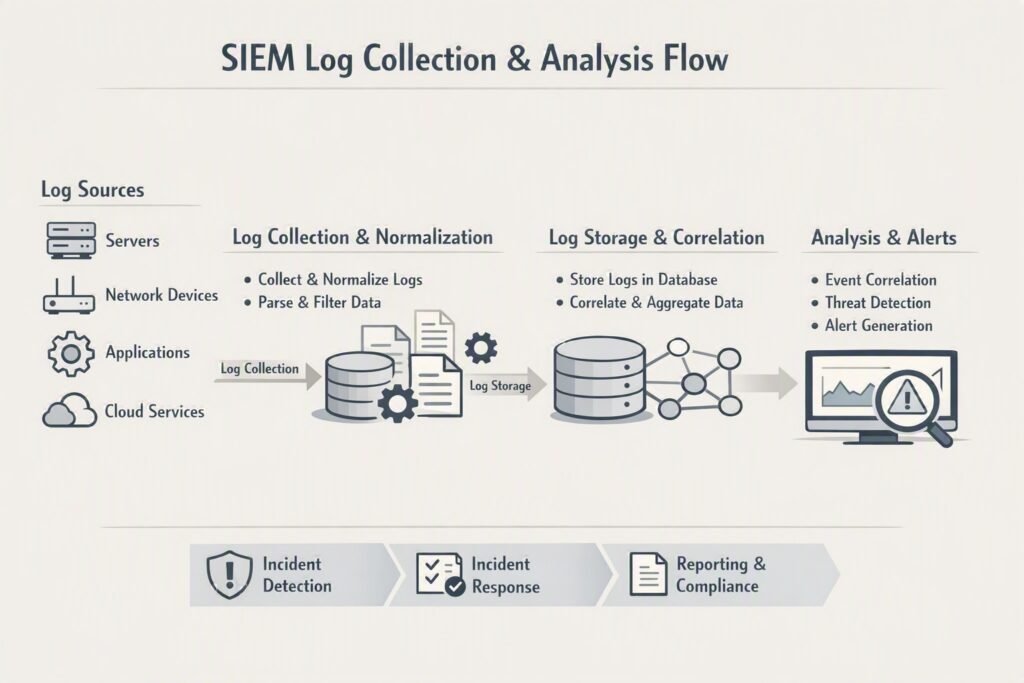
3.Correlation & Enrichment: Connecting the Dots.
This is where the platform becomes intelligent. The correlation engine looks across normalized logs to identify patterns that match known attack techniques. It enriches raw data with external context, such as live threat intelligence feeds to flag known malicious IPs, and asset metadata to identify if the targeted machine holds critical customer data.
4.Alerting & Case Triage: Engaging the Defenders.
When a correlation rule or a machine learning anomaly detection model triggers a high-confidence match, the system generates an alert. This alert is grouped into a structured case file, complete with all supporting telemetry, allowing SOC analysts to immediately begin incident containment and response.
Traditional vs. Cloud-Native vs. AI-Native SIEM
The security monitoring landscape is undergoing a massive architectural shift. Driven by rapid global cloud infrastructure growth, traditional on-premises setups are giving way to agile, scalable, and highly automated architectures.
Let’s look at how the different generations of monitoring platforms compare when deployed in modern enterprise networks:
| Capability | Traditional SIEM (Legacy) | Cloud-Native SIEM (SaaS) | AI-Native / Open XDR |
| Primary Correlation Engine | Rigid, manual correlation rules (if-this-then-that) | Cloud-scale correlation with basic machine learning | Agentic AI, behavioral analytics, and automated triage |
| Data Storage & Scaling | Expensive on-premises hardware; rigid storage limits | Highly scalable cloud storage; ingestion-based pricing | Optimized data lakes with cold, low-cost archive tiers |
| Noise & Alert Fatigue | High false positives; requires continuous manual rule tuning | Moderate; rules are updated faster but alert volume remains high | Very low; autonomous AI triages and groups related alerts |
| Implementation Complexity | Heavy; requires weeks or months of hardware provisioning | Rapid; cloud collectors configure in days via APIs | Fast; heavily relies on automated asset mapping and discovery |
Real-World Operational Realities: Moving Beyond the Hype
While software vendors love to pitch the dream of an instantly automated, perfect security shield, the reality on the ground is often much tougher. A common pain point among SOC managers is that many organizations purchase a security platform but fail to fully operationalize it.
To ensure your monitoring architecture delivers measurable value rather than just a massive monthly storage bill, you must design around three core operational realities.
1. The Fallacy of Average EPS (Events Per Second)
When sizing your logging platform for licensing, storage, and processing performance, designing for your average EPS is a recipe for system crashes.
Enterprise networks do not generate data at a smooth, predictable rate. Activity spikes dramatically during morning login windows, scheduled network backups, or—worst of all—during an actual active security incident when systems generate millions of rapid-fire error logs and security alerts.
Always architect your ingestion pipeline to handle peak EPS, rather than the baseline average. A failure to build a resilient buffer into your architecture can cause log delays precisely when your incident response team needs real-time visibility the most.
2. Prioritizing High-Value Over High-Volume Data
One of the fastest ways to exhaust your security budget is to ingest every single log your company’s infrastructure produces. More data does not automatically equal more security.
Ingesting verbose debug logs from local development servers, raw application performance metrics, or redundant network packet captures will skyrocket your storage costs while adding zero security value.
Instead, a systematic literature review of deployment strategies shows that high-performing security programs focus heavily on critical “high-fidelity” sources:
- Identity Providers (IdP): Authentication logs (showing where, when, and how users log in).
- Endpoint Detection and Response (EDR): High-fidelity alerts directly from user workstations and servers.
- Cloud Control Planes: Administrative logs showing configuration changes, new resource creation, and privilege escalations.
- Web Application Firewalls (WAF): Real-time web application probes and payload attacks.
3. Combatting the High Cost of Data Retention
Keeping hundreds of terabytes of data indexed and instantly searchable is incredibly expensive. However, regulatory requirements often dictate that organizations keep logs accessible for years.
To balance visibility with budgetary constraints, modern engineering teams utilize a tiered data strategy. By leveraging cold storage archives, teams can achieve a reducing total cost of ownership by 30% to 45% while still complying with compliance mandates. This keeps hot, indexed storage reserved strictly for active threat hunting and real-time detection.
How SIEM Log Analysis Works
1. Normalization
Every system writes logs differently.
A firewall may record:
- Source IP
- Destination IP
- Port
A cloud platform may record:
- User activity
- API calls
- Authentication events
Normalization converts these different formats into a consistent data structure.
Exabeam notes that SIEM platforms aggregate and normalize logs into a unified format, making data analysis significantly more effective.
2. Correlation
Correlation is where SIEM becomes intelligent.
Instead of looking at isolated events, the platform connects related activities.
Examples include:
- Multiple failed logins followed by a successful login
- Privilege escalation after account creation
- Large data transfers after unusual authentication activity
These patterns often signal malicious behavior.
3. Behavioral Analysis
Modern SIEM platforms increasingly use:
- Machine learning
- User behavior analytics (UEBA)
- Anomaly detection
IBM notes that modern SIEM solutions have evolved beyond basic log management to include advanced analytics and behavioral monitoring capabilities.
Behavioral analysis helps answer questions such as:
- Is this user accessing systems at unusual times?
- Is this administrator performing atypical activities?
- Is this endpoint behaving differently from its baseline?
Best Practices for Effective SIEM Operations (Log Aggregation and Analysis)
Prioritize High-Value Log Sources
Start with:
- Authentication logs
- Endpoint security logs
- Firewall events
- Cloud activity logs
- Active Directory events
These typically provide the highest security value.
Create Use-Case Driven Detection Rules
Avoid collecting logs without a purpose.
Instead, ask:
- What threats am I trying to detect?
- What attack techniques concern my organization?
- Which logs support those detections?
A detection-first approach delivers better results.
Continuously Tune Alerts
SIEM operations are never “set and forget.”
Security teams should regularly:
- Remove noisy alerts
- Refine detection rules
- Adjust severity levels
- Incorporate threat intelligence
Automate Repetitive Tasks
Security analysts should not spend their day performing repetitive triage.
Automation can help:
- Enrich alerts
- Assign severity
- Gather context
- Trigger response workflows
This lowers response times while improving consistency.
The Path Forward
At its core, SIEM Operations (Log Aggregation and Analysis) is about transforming overwhelming volumes of security data into actionable intelligence.
Successful SIEM programs do much more than collect logs. They aggregate information from across the environment, normalize disparate data, correlate events, identify suspicious patterns, and enable faster incident response.
The most effective security teams understand a critical truth: security visibility is not created by having more logs—it is created by having better analysis.
As cyber threats continue to grow in sophistication, organizations that treat SIEM as a strategic security capability rather than just a compliance requirement will gain a significant operational advantage.
Pingback: Roadmap to the Cybersecurity world - The Cyber Server