Imagine running an exclusive high-end club. In the early days of network security, security guards stood at the front door with a clipboard checking names and matching them against a basic guest list. If a visitor’s name, originating location, and declared purpose matched the ledger, they walked straight through. The guards didn’t check what was inside the visitor’s briefcase, nor did they monitor what the guest did once they stepped inside the lounge.
For decades, this was the baseline for securing corporate infrastructure. However, as cybercriminals swapped simple lockpicks for digital invisibility cloaks and AI-powered social engineering, this surface-level screening became a liability. This brings us to the core dilemma of modern infrastructure architecture: the fundamental division between traditional Stateful and Next-Generation Firewalls (NGFW).
To build a resilient enterprise network, security leaders must look beyond marketing buzzwords. Understanding the mechanical, architectural, and operational realities of these two technologies determines whether your perimeter remains a true fortress or becomes an open gateway for modern threats.
The Sentinel of the Past: Demystifying Stateful Firewalls
To appreciate the rise of next-generation defenses, we must first understand the architecture that laid the groundwork. Introduced in the 1990s as a major upgrade to static packet filtering, stateful inspection revolutionized network engineering.
A traditional static packet filter evaluates every single piece of data in isolation. It checks the source IP address, the destination IP address, the protocol, and the port number against an access control list (ACL). If a packet arrives out of sequence or completely detached from an ongoing conversation, a static filter often lacks the context to recognize it as an anomaly.
A stateful firewall represents a major evolution over traditional packet-filtering firewalls.
Unlike stateless firewalls, which inspect each packet independently, stateful firewalls maintain a record of active network sessions. This allows them to understand whether incoming traffic is part of an established connection or an unsolicited request.
Stateful firewalls maintain a connection table, commonly known as a state table. When a user initiates a legitimate connection, the firewall records key session details such as:
- Source IP address
- Destination IP address
- Port numbers
- Protocol information
- Connection state
When reply traffic arrives, the firewall checks the state table before allowing access.
Key Advantages
- Better security than simple packet filtering
- Efficient handling of legitimate return traffic
- Lower complexity compared to advanced security systems
- Strong performance for traditional network environments
Limitations
Despite their importance, stateful firewalls have limitations:
- Limited visibility into application-level activity
- Difficulty identifying sophisticated threats
- Restricted inspection of encrypted traffic
- Little awareness of user identity or application behavior
According to Cisco’s overview of NGFW technology, traditional stateful firewalls primarily make decisions based on state, ports, and protocols, while modern threats increasingly operate at the application layer.
Tracking the Conversation
Stateful inspection changed this by introducing state tables. Instead of analyzing data in silos, a stateful firewall monitors the entire lifecycle of a network connection. When an internal user initiates a request to an external server—such as opening a connection via Transmission Control Protocol (TCP)—the firewall notes the handshake. It records the session state, the source and destination details, and the ephemeral ports involved in its internal memory.
When the external server responds, the firewall checks its state table. If the incoming traffic matches an open, active conversation initiated from the inside, the firewall permits passage without forcing the data through another slow checklist of rules. This process speeds up throughput and provides essential protection against basic spoofing attacks and unsolicited external incoming requests.
The Limits of the Envelope
Despite these capabilities, stateful firewalls operate with a severe blind spot: they only read the envelope, never the letter inside. They process traffic primarily at Layer 3 (the Network Layer) and Layer 4 (the Transport Layer) of the Open Systems Interconnection (OSI) model.
If an attacker hides malicious code inside legitimate HTTP traffic over Port 80, a stateful firewall will see a valid outbound web session and let it pass. It lacks the architectural depth to look past the header fields and analyze the actual data payload. This vulnerability is exactly what modern exploit kits and ransomware strains are designed to target.
The Evolutionary Leap: What Makes a Firewall Next-Generation?
As enterprise systems migrated to cloud platforms and SaaS applications became standard, the old network boundaries started to dissolve. Port-based rules lost their effectiveness when web traffic began sharing the same standard communication paths.
Next-generation solutions address this challenge by extending inspection all the way up to Layer 7 (the Application Layer) of the OSI model. An NGFW combines the core state-tracking abilities of traditional systems with advanced inspection capabilities, all handled by a single, integrated engine.
A Next-Generation Firewall (NGFW) builds on the foundation of a stateful firewall while adding advanced inspection and threat prevention capabilities.
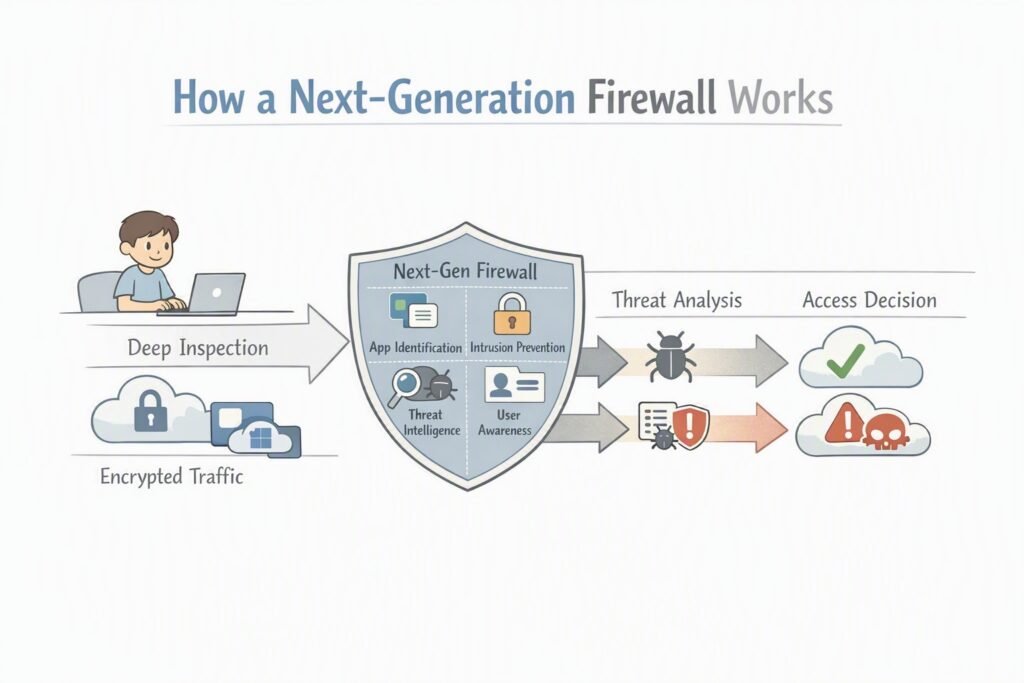
Industry definitions commonly describe an NGFW as a firewall that combines:
- Stateful inspection
- Intrusion Prevention System (IPS)
- Application awareness and control
- Threat intelligence integration
- Advanced malware protection
Cisco notes that application awareness and integrated threat prevention are fundamental characteristics that distinguish NGFWs from traditional stateful firewalls.
Why NGFWs Emerged
The traditional security model assumed that blocking unauthorized network connections was enough.
Modern environments changed everything:
- Cloud applications dominate business operations
- Employees work remotely
- Encrypted traffic has become the norm
- Attackers abuse legitimate applications
As a result, organizations need security controls that understand context rather than simply examining ports and protocols.
An NGFW does not treat security as a simple gatekeeping step. Instead, it processes data through multiple layers of deep evaluation, applying granular policies and security services to make context-aware decisions. Let’s break down the core components that enable this level of protection.
1. Deep Packet Inspection (DPI)
While traditional systems inspect only the packet headers, Deep Packet Inspection allows an NGFW to read the entire data payload. It evaluates the actual contents of the transmission to identify hidden exploits, malware signatures, and anomalous behaviors.
By analyzing the structure of the data stream rather than relying on port numbers, DPI helps prevent hackers from masking unauthorized data transfers or command-and-control communications under the guise of safe web browsing.
2. Application Awareness and Control
In modern networks, blocking Port 80 or Port 443 is rarely an option, as doing so would disrupt critical business applications. However, allowing unrestricted access creates significant security gaps.
NGFWs solve this through application awareness. The firewall identifies the exact software generating the traffic, regardless of the port it uses. For example, a security policy can be configured to allow users to access a collaborative platform like Microsoft Teams while simultaneously blocking high-risk file-sharing extensions or unauthorized file transfers within that same application.
3. Integrated Intrusion Prevention Systems (IPS)
Historically, protecting a network against active exploits required deploying a standalone Intrusion Prevention System behind the perimeter firewall. This approach added latency, increased architectural complexity, and created separate reporting streams.
An NGFW integrates signature-based and anomaly-based IPS directly into its processing path. This inline integration enables the system to spot known software vulnerabilities, buffer overflows, and network-level attacks as they occur, blocking the threat before it reaches internal servers.
4. Identity Management and User Awareness
Network security is no longer defined solely by static IP addresses. With hybrid work models, an IP address can change multiple times a day as a user shifts from an office workstation to a home connection or a public network.
By integrating with enterprise identity ecosystems like Active Directory, Okta, or Azure AD, an NGFW associates network activity with specific user accounts and security groups. This allows administrators to enforce granular access privileges, ensuring that sensitive environments—such as accounting databases or source code repositories—are accessible only to authorized roles, regardless of their physical location or current IP address.
Side-by-Side Comparison: Stateful vs. NGFW
To help determine where each technology fits within a modern deployment strategy, the table below highlights the key technical and operational differences between stateful inspection and next-generation platforms.
| Feature / Capability | Stateful Firewalls | Next-Generation Firewalls (NGFW) |
| OSI Layer Operation | Operates at Layers 3 and 4 (Network & Transport) | Operates from Layers 3 up to Layer 7 (Application) |
| Inspection Depth | Header analysis only (IP, Port, Protocol) | Deep Packet Inspection (DPI) of header and payload |
| Application Visibility | Blind to applications; relies entirely on port numbers | Native application awareness and granular control |
| Threat Prevention | Basic packet filtering and connection validation | Integrated IPS, antivirus, sandboxing, and threat intelligence |
| User Identity Integration | None; creates rules based strictly on IP addresses | Deep integration with identity systems (AD, LDAP, SAML) |
| Decryption Capabilities | Lacks the processing power to decrypt SSL/TLS traffic | Inline SSL/TLS decryption, inspection, and re-encryption |
| Processing Performance | High throughput with minimal processing overhead | Requires hardware acceleration or specialized ASICs |
Advanced Insights: Enterprise Security Realities
Moving beyond checkboxes and feature lists reveals the real-world operational challenges that security teams encounter when managing next-generation platforms.
The True Cost of SSL/TLS Decryption
With the vast majority of web traffic encrypted via SSL and TLS, visibility has become a double-edged sword. While encryption protects data privacy, it also serves as a primary evasion tactic for cybercriminals, who use encrypted channels to deliver malware and coordinate data exfiltration.
To counter this, modern enterprise NGFW platforms feature specialized hardware acceleration designed to decrypt, inspect, and re-encrypt traffic inline. However, deploying full decryption requires careful planning. Turning on SSL inspection across an entire enterprise can impact firewall throughput and introduce potential latency if the hardware is not properly sized.
Furthermore, organizations must design precise bypass rules to handle sensitive data categories, ensuring that employee privacy and regulatory compliance are maintained by excluding financial and healthcare-related traffic from the decryption path.
The Role of Firewalls in a Zero Trust World
The concept of a secure corporate perimeter has changed dramatically. As workloads move to multi-cloud environments and remote access becomes the norm, security strategies are shifting toward Zero Trust architectures, which operate on the principle of continuous verification.
Within this framework, NGFWs serve a vital role by acting as policy enforcement points. Rather than just protecting the outer edge of the network, modern virtual and containerized firewalls are deployed internally to micro-segment environments. By isolating workloads within cloud platforms and data centers, these deployments help prevent lateral movement, ensuring that a compromise in an isolated development environment cannot easily spread to production databases.
Machine Learning and Automated Defenses
The speed at which new threats emerge makes relying solely on static signature updates insufficient. Modern firewall ecosystems integrate machine learning algorithms directly into the inspection data path to analyze threat patterns in real time.
When an NGFW encounters an unknown file or an unusual data pattern, it can run the suspicious code within a cloud-based sandbox environment. By observing the behavior of the file in isolation, the system can identify zero-day exploits and distribute defensive updates across an organization’s entire security infrastructure within minutes, preventing widespread infection.
The Most Important Difference: Visibility
When evaluating Stateful and Next-Generation Firewalls (NGFW), visibility is often the deciding factor.
Imagine a stateful firewall observing traffic over HTTPS on port 443.
It sees:
- The connection
- Source and destination
- Session state
But it may not fully understand:
- Which application generated the traffic
- Whether the application is authorized
- Whether hidden malware is present
An NGFW attempts to answer those questions.
Instead of merely identifying traffic as HTTPS, it can recognize:
- Microsoft 365
- Dropbox
- WhatsApp Web
- Zoom
- Custom business applications
This context enables much more precise security policies.
When to Deploy an NGFW
An NGFW should serve as your primary perimeter defense. Any network segment directly exposed to the internet, handling remote user traffic, or connecting to public cloud environments requires the application-layer visibility and automated threat prevention that only an NGFW can provide.
When a Stateful Firewall Is Sufficient
Traditional stateful firewalls remain highly effective for internal routing micro-segmentation where low latency and high throughput are the primary requirements. For example, isolating high-speed storage area networks (SANs) or separating internal automated testing zones from production segments often only requires basic network-layer boundaries. Using a stateful firewall in these scenarios keeps costs down and avoids the processing overhead of deep packet inspection.
Not every environment requires a full NGFW deployment.
Stateful firewalls remain useful in:
- Small isolated networks
- Internal network segmentation
- High-performance environments with limited inspection needs
- Cost-sensitive deployments
For organizations with simple connectivity requirements and minimal exposure, a properly configured stateful firewall may still provide adequate protection.
The mistake is assuming that all environments fall into this category.
Real-World Example: The Port 443 Problem
One lesson I’ve learned from security deployments is that focusing on ports alone often creates blind spots.
Years ago, blocking specific ports significantly reduced risk because applications typically used dedicated communication channels.
Today, almost everything uses HTTPS over port 443.
This means:
- Business software uses it
- Social media uses it
- File-sharing services use it
- Malware uses it
If security decisions rely only on ports, organizations lose visibility.
NGFWs address this challenge through application identification techniques that differentiate between legitimate and risky traffic even when both use the same network port.
This single capability is often what justifies the investment for many companies.
Conclusion: Securing the Path Forward
The choice between stateful inspection and next-generation firewalls is not about discarding older technologies; it is about deploying the right tool for the specific risk environment. Stateful firewalls offer efficient, high-speed connection tracking for well-defined internal zones, while next-generation firewalls provide the deep visibility, identity integration, and threat intelligence needed to defend against sophisticated modern attacks.
Maintaining a strong security posture requires continuous assessment of your network architecture. Take the time to audit your current perimeter defenses, identify areas where encrypted traffic might be creating visibility gaps, and ensure your segmentation strategies align with a zero-trust approach.
The debate between Stateful and Next-Generation Firewalls (NGFW) isn’t really about choosing one over the other. NGFWs incorporate the strengths of stateful inspection while extending protection to meet today’s threat landscape.
Stateful firewalls remain effective for controlling network sessions and enforcing foundational security policies. However, modern organizations increasingly need visibility into applications, users, encrypted traffic, and emerging threats—areas where NGFWs excel.
The most important takeaway is this: security is no longer just about controlling connections. It’s about understanding what’s happening inside those connections.
Organizations that recognize this shift are far better positioned to defend against modern cyber threats.
Pingback: Roadmap to the Cybersecurity world - The Cyber Server