Have you ever paused to wonder how a simple tap on your smartphone screen in London can trigger a server response in San Francisco in less than a blink of an eye? Behind that seamless experience lies a complex, invisible architecture that coordinates billions of devices. If the internet is the world’s most massive highway system, then The OSI Model and TCP/IP Stack are the blueprints, traffic laws, and logistics manifests that keep everything from descending into total chaos.
In the early days of computing, networking was a bit like the Wild West. Different manufacturers created proprietary systems that couldn’t talk to one another. If you bought IBM, you were stuck with IBM. The birth of standardized models changed everything, ushering in the era of global connectivity we often take for granted today. Whether you are an aspiring network engineer, a developer, or just a curious tech enthusiast, understanding these models is like learning the grammar of the internet.
The Birth of a Standard: Why We Need Models
Before we dive into the layers, it is essential to understand why these frameworks exist. A networking model provides a “common language” for hardware and software developers. By breaking the complex process of communication into smaller, manageable chunks (layers), engineers can focus on one specific aspect without worrying about the others.
For instance, the person designing a new fiber-optic cable (Physical Layer) doesn’t need to know how a web browser renders HTML (Application Layer). They only need to ensure that the bits move from point A to point B. This modularity is the secret sauce behind technological innovation.
Breaking Down the OSI Model: The 7-Layer Cake
The Open Systems Interconnection (OSI) model was developed by the International Organization for Standardization (ISO) in the late 1970s. While it is often considered more of a theoretical framework today, it remains the gold standard for teaching networking logic.
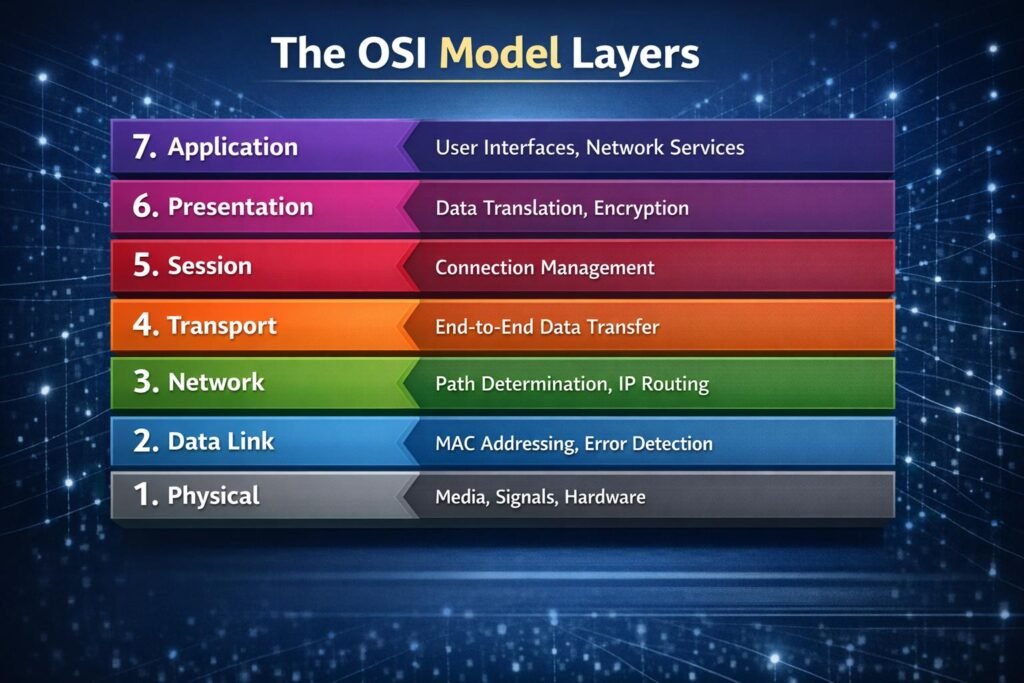
1. The Physical Layer
This is the “ground floor.” It deals with the actual hardware—cables, connectors, and the electrical signals or light pulses that represent binary data. When you troubleshoot a “dead” internet connection by checking if the Ethernet cable is plugged in, you are working at Layer 1.
2. The Data Link Layer
Layer 2 is responsible for node-to-node data transfer. It packages raw bits from the Physical Layer into “frames.” This is where Media Access Control (MAC) addresses live. If you’ve ever configured a network switch, you’ve interacted with the Data Link Layer.
3. The Network Layer
The Network Layer is the “postal service” of the model. It handles routing and forwarding of data packets across different networks. This is the home of the Internet Protocol (IP) and logical addressing. It determines the best physical path for the data to take.
4. The Transport Layer
This layer ensures that data is delivered reliably. It breaks large files into smaller segments and handles error correction. The most famous protocols here are TCP (Transmission Control Protocol), which guarantees delivery, and UDP (User Datagram Protocol), which prioritizes speed over reliability.
5. The Session Layer
The Session Layer manages the “conversation” between devices. It opens, maintains, and terminates the connection. Think of it as the coordinator that ensures that if a connection drops, it can be resumed from the last checkpoint rather than starting from scratch.
6. The Presentation Layer
This layer acts as a translator. It ensures that the data is in a format the receiving application can understand. It handles encryption (like SSL/TLS), compression, and data formatting (converting EBCDIC to ASCII, for example).
7. The Application Layer
The top layer is the one you interact with directly. Protocols like HTTP (web browsing), SMTP (email), and FTP (file transfer) live here. It’s the interface between the user and the network.
The TCP/IP Stack: The Real-World Workhorse
While the OSI model is great for textbooks, the TCP/IP Stack (also known as the Internet Protocol Suite) is what the internet actually runs on. Developed by the Department of Defense (DoD), it is more streamlined and pragmatic.
The TCP/IP model typically consists of four layers that map loosely to the seven OSI layers:
- Application Layer: Combines OSI Layers 5, 6, and 7.
- Transport Layer: Maps directly to OSI Layer 4.
- Internet Layer: Maps to OSI Layer 3.
- Network Access Layer: Combines OSI Layers 1 and 2.
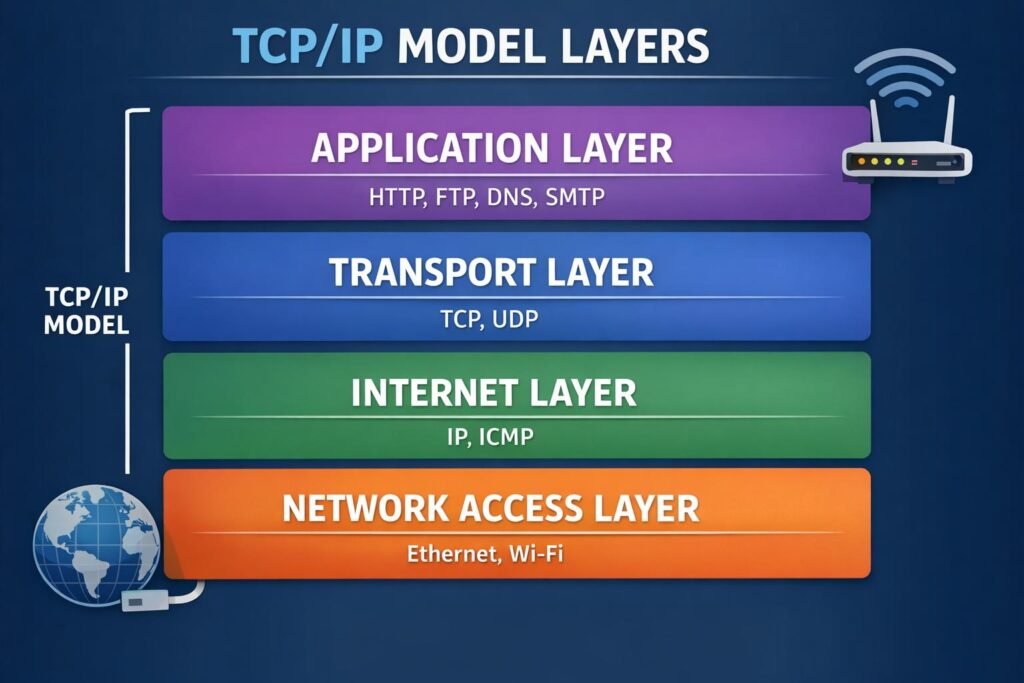
The beauty of the TCP/IP stack is its resilience. It was designed to keep communicating even if parts of the network were destroyed (a cold-war era requirement), which is why it became the foundation of the modern internet.
OSI vs. TCP/IP: A Comparative Look
Understanding the differences between these two is a common requirement for certifications like the CCNA. Here is a quick reference guide:
| Feature | OSI Model | TCP/IP Stack |
| Development | Developed by ISO (Standards body) | Developed by ARPANET/DoD (Research) |
| Number of Layers | 7 Layers | 4 Layers |
| Approach | Theoretical / Rigid | Practical / Flexible |
| Status | Used for teaching/troubleshooting | The actual implementation of the internet |
| Transport Layer | Connection-oriented & Connectionless | Both (TCP and UDP) |
| Usage | Helping engineers visualize flow | Building real-world network protocols |
The Invisible Ballet: Encapsulation and Decapsulation
One of the most fascinating “behind the scenes” processes in The OSI Model and TCP/IP Stack is encapsulation. Imagine you are sending an email.
- Application: Your email data is created.
- Transport: A TCP header is added (containing port numbers). Now it’s a Segment.
- Network: An IP header is added (containing IP addresses). Now it’s a Packet.
- Data Link: A MAC header and trailer are added. Now it’s a Frame.
- Physical: The frame is converted into electrical signals (bits) and sent over the wire.
On the receiving end, the process reverses—this is called Decapsulation. Each layer “unwraps” its corresponding header until only the original email data remains for the recipient to read.
Expert Insight: In modern cloud computing and Software-Defined Networking (SDN), these layers are becoming increasingly abstracted. However, when things break—when a packet drops or a latency spike occurs—you invariably have to go back to these fundamentals to find the “where” and “why” of the failure.
Modern Perspectives: Does the Model Still Matter?
In the age of serverless functions, microservices, and 5G, some argue that the 7-layer OSI model is outdated. While it’s true that modern protocols often “blur the lines” between layers (for example, Layer 7 switches that perform load balancing based on Application data), the logic remains essential.
Consider the rise of Cybersecurity. Most modern attacks target specific layers. A Distributed Denial of Service (DDoS) attack might target the Network Layer (Layer 3) to overwhelm bandwidth, or it might target the Application Layer (Layer 7) by flooding a specific web form. Without a clear understanding of the stack, defending against these threats is nearly impossible.
Personal Experience: The “Layer 8” Problem
In my years working with network infrastructure, I’ve learned that the most important layer isn’t even in the official documentation: Layer 8, the User Layer.
I once spent four hours troubleshooting a complex routing issue (Layer 3) only to realize the client had accidentally turned off their Wi-Fi toggle on their keyboard. This highlights a key lesson: always troubleshoot from the bottom up. Check your physical connections first before you start reconfiguring your BGP routing tables!
Best Practices for Navigating the Stack
If you are looking to master The OSI Model and TCP/IP Stack, here are a few actionable tips:
- Start Bottom-Up: When troubleshooting, always verify the Physical and Data Link layers before moving to IP routing or Application settings.
- Use Tools for Visualization: Use software like Wireshark to actually see the encapsulation process in real-time. Seeing the headers on a live packet is worth a thousand textbook pages.
- Don’t Over-Memorize: Focus on the purpose of each layer. If you understand that the Transport layer is about “reliability,” you’ll naturally remember that TCP lives there.
- Stay Updated on IPv6: As we transition from IPv4 to IPv6, the Network Layer (Layer 3) is undergoing its biggest change in decades. Understanding how the headers differ is crucial for the future.
Conclusion
The OSI Model and TCP/IP Stack are more than just academic theories; they are the skeletal structure of our digital existence. They allow a diverse world of hardware and software to harmonize, enabling the global exchange of ideas, commerce, and connection. By mastering these layers, you aren’t just learning how computers talk—you’re learning how the modern world stays connected.
Technological trends will come and go. We will move from 5G to 6G, and from local servers to edge computing. Yet, the fundamental logic of moving data from an application, across a network, and onto a physical medium will remain.
Pingback: Roadmap to the Cybersecurity world - The Cyber Server
Pingback: IPv4/IPv6 Addressing and Subnetting: A Practical Guide for Modern Networks - The Cyber Server