If you’ve ever designed a network that looked perfect on paper but unraveled in production, chances are addressing and subnetting were part of the problem. IPv4/IPv6 Addressing and Subnetting sit quietly beneath every digital interaction, yet a single poor decision here can lead to bottlenecks, security gaps, or costly redesigns.
In my early networking days, subnetting felt like abstract math—something you memorized for exams and forgot afterward. That changed the first time I had to re‑address a live enterprise network because someone underestimated growth. That experience made one thing clear: understanding IP addressing isn’t optional anymore—it’s foundational.
In this article, we’ll explore IPv4 and IPv6 addressing from a practical, real‑world perspective, examine how subnetting actually influences scalability and security, and uncover why moving to IPv6 is less about replacement and more about coexistence.
Understanding IPv4 Addressing: Familiar, Functional, and Finite
IPv4 has powered the internet for decades, assigning addresses using a 32‑bit format. This structure allows for just over 4 billion unique addresses—a number that once seemed astronomical but is now insufficient.
According to the Internet Assigned Numbers Authority (IANA), the global IPv4 address pool has been officially exhausted, making address conservation a daily challenge for network architects.
Click here to read about OSI and TCP models.
Why IPv4 Still Dominates
Despite exhaustion, IPv4 persists due to:
- Massive legacy infrastructure
- Mature tooling and troubleshooting practices
- Widespread use of Network Address Translation (NAT)
Organizations rely on IPv4 because it works—and because replacing it all at once isn’t realistic.
Subnetting in IPv4: More Than an Exam Topic
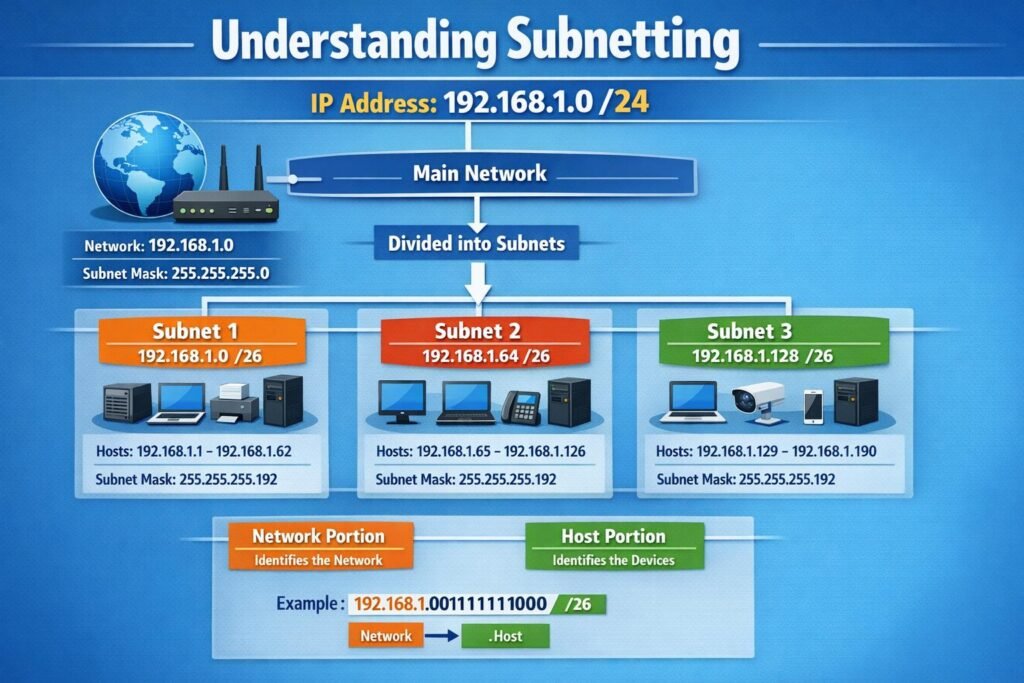
Subnetting allows administrators to divide a network into smaller, manageable segments. Beyond conserving addresses, subnetting:
- Reduces broadcast traffic
- Improves network performance
- Supports logical segmentation for security
When applied thoughtfully, subnetting becomes a design tool—not just an addressing technique.
IPv6 Addressing: Designed for Scale, Security, and Simplicity
IPv6 was introduced to fix IPv4’s limitations, but its benefits go far beyond address count. With 128‑bit addressing, IPv6 offers an almost limitless address space—enough to assign unique addresses to every device imaginable.
The Internet Society describes IPv6 adoption as a critical step toward long‑term internet sustainability, especially with the rise of IoT and cloud computing.
What Makes IPv6 Different
IPv6 improves networking in several meaningful ways:
- Vast address availability eliminates the need for NAT
- Built‑in support for IPsec strengthens security
- Stateless Address Autoconfiguration (SLAAC) simplifies deployments
From experience, teams that embrace IPv6 often find network designs become cleaner—less workaround‑driven and more intentional.
Why IPv6 is considered Safer
- Massive Scanning Resistance: The sheer mathematical scale makes brute-force network scanning virtually impossible; while an IPv4 subnet can be mapped in seconds, a single IPv6 /64 subnet contains $2^{64}$ (roughly 18 quintillion) addresses, meaning an attacker would need lifetimes to find a single active host.
- Native IPsec Support: Mandatory support for IPsec was baked into the protocol’s architecture from the start, providing a standardized framework for encryption and authentication that was merely an optional, “bolted-on” afterthought in IPv4.
- Cryptographic Neighbor Discovery: IPv6 replaces the easily spoofed Address Resolution Protocol (ARP) with the Neighbor Discovery Protocol (NDP), which can be hardened using SEND (Secure Neighbor Discovery) to cryptographically verify device identities and prevent common man-in-the-middle attacks.
- Privacy Extensions: It utilizes privacy extensions that allow devices to generate temporary, randomized interface identifiers that rotate periodically, preventing malicious actors or advertisers from tracking a specific device’s “fingerprint” as it moves between different networks.
- Elimination of NAT Complexity: By removing the need for Network Address Translation (NAT), it restores true end-to-end connectivity, making it easier for security tools and firewalls to identify the genuine source and destination of traffic without the obfuscation caused by shared public IPs.
- Hierarchical Addressing: The structured, hierarchical nature of IPv6 allows for much cleaner and more efficient firewall rules and route aggregation, reducing the likelihood of human error or “leaky” configurations in complex access control lists.
- Simplified Header Processing: The streamlined header design allows security appliances and routers to process packets more efficiently, which reduces the performance penalty often associated with deep packet inspection and real-time threat detection.
IPv4 vs IPv6 Addressing: A Practical Comparison
| Feature | IPv4 | IPv6 |
|---|---|---|
| Address Length | 32‑bit | 128‑bit |
| Address Space | ~4.3 billion | Virtually unlimited |
| NAT Requirement | Common | Not required |
| Security | Optional | Built‑in IPsec |
| Configuration | Manual/DHCP | SLAAC/DHCPv6 |
| Header Complexity | More fields | Simplified |
Subnetting vs Prefixing: Where IPv4 and IPv6 Diverge
While IPv4 relies heavily on subnet masks, IPv6 uses prefix lengths to define networks. The logic is similar, but the philosophy is different.
IPv4 Subnetting: Precision Matters
IPv4 subnetting is typically driven by address scarcity. Engineers often design networks backwards—starting with minimal host requirements and carving addresses carefully.
This precision can improve efficiency but increases complexity and human error, especially under time pressure.
IPv6 Prefixing: Design for Growth
IPv6 subnetting (often called prefixing) encourages generous allocations. Instead of conserving addresses, the focus shifts to:
- Hierarchical design
- Simplified routing
- Long‑term scalability
The American Registry for Internet Numbers (ARIN) actively recommends structured IPv6 prefix planning to avoid future renumbering.
Mastering the Subnetting Math
To truly master IPv4/IPv6 Addressing and Subnetting, one must embrace the binary. While calculators exist, understanding the “Magic Number” method for IPv4 is a rite of passage for any networking professional.
If you are given an address like 192.168.10.45 /27, how do you find the network address?
- Find the bits: A /27 means 27 bits are turned on for the mask. In the last octet, that’s 3 bits (128+64+32 = 224).
- Find the Magic Number: Subtract the mask from 256. (256 – 224 = 32).
- Find the Network: The subnets will go in increments of 32 (0, 32, 64…). Since .45 is between 32 and 64, the network ID is 192.168.10.32.
In IPv6, we don’t do this “bit-shaving” as often because we almost always stay on nibble boundaries (multiples of 4 bits). This makes IPv6 subnetting significantly easier to read at a glance, provided you are comfortable with hexadecimal.
Key Insights from Real‑World Network Design
NAT Is a Convenience—and a Constraint
NAT helped extend IPv4’s lifespan, but it introduces hidden complexity. Troubleshooting multi‑layer NAT environments often feels like detective work.
IPv6 removes this requirement entirely, restoring end‑to‑end connectivity while simplifying logging and security policies.
Subnetting Shapes Security Boundaries
Well‑planned subnetting acts as a first layer of defense. Segmenting workloads—servers, users, IoT—reduces attack surfaces and simplifies policy enforcement.
In zero‑trust network models, address design becomes a strategic decision rather than an afterthought.
Dual‑Stack Is the Real Transition Strategy
Most organizations don’t “switch” to IPv6. They adopt dual‑stack environments where IPv4 and IPv6 coexist.
Cloud providers like Amazon Web Services and Microsoft Azure natively support dual‑stack networking, reinforcing that IPv6 adoption is incremental, not disruptive.
Practical Use Cases Where IPv6 Shines
- Cloud‑native applications needing massive address scale
- IoT deployments with millions of endpoints
- Global enterprises requiring simplified routing policies
In these environments, IPv6 isn’t experimental—it’s operationally superior.
Common Myths About IPv4/IPv6 Addressing and Subnetting
- “IPv6 is too complex” – Most complexity comes from unfamiliarity, not design.
- “IPv4 will never disappear” – True, but that doesn’t negate IPv6’s advantages.
- “Subnetting is only for large networks” – Even small networks benefit from proper segmentation.
Conclusion: Addressing Is Architecture, Not Administration
At its core, IPv4/IPv6 Addressing and Subnetting define how scalable, secure, and resilient your network can be. IPv4 taught us efficiency. IPv6 teaches us foresight.
The most effective engineers I’ve worked with treat addressing as architecture—not paperwork. They design with growth in mind, document intentionally, and avoid shortcuts that create technical debt.
The future of networking isn’t about choosing between IPv4 and IPv6. It’s about understanding both deeply enough to design systems that last.
The logic of IPv4/IPv6 Addressing and Subnetting remains the foundational literacy of the internet. It is about understanding how data finds its way home across a web of billions of devices. Whether you are calculating a /24 for a home lab or a /48 for a multinational corporation, you are participating in the grand engineering feat that keeps our world connected.
Pingback: Roadmap to the Cybersecurity world - The Cyber Server