Imagine sitting at your desk when a low-severity alert fires: a single workstation in finance is executing an unusual PowerShell script. Your legacy antivirus did not blink because the script uses legitimate, native administrative tools built into the operating system. This is the reality of modern enterprise security, where sophisticated attackers no longer break in—they log in, or they blend in using the very tools your team uses every day.
To counter these highly evasive threats, organizations have turned heavily toward Endpoint Detection and Response (EDR/XDR) as their primary line of defense. But as the corporate perimeter dissolves into multi-cloud environments, decentralized workforces, and thousands of interconnected software-as-a-service applications, the question isn’t just about protecting individual devices anymore. It is about connecting the dots across your entire digital landscape to stop attackers before they can establish a foothold.
The Indispensable Foundation: What is EDR?
Traditional cybersecurity was heavily reliant on signature-based prevention. If a file matched a known piece of malware, the system blocked it. However, if a brand-new, zero-day threat slipped past, or if an attacker used custom scripts, the system was completely blind.
Endpoint Detection and Response (EDR) flipped this paradigm on its head. Think of EDR less like a lock on your front door and more like a continuous flight data recorder for your devices. It installs a lightweight agent on endpoints—such as laptops, desktops, servers, and mobile devices—to monitor process executions, registry modifications, network connections, and file system behavior in real time.
By applying advanced behavioral analytics and machine learning to this massive stream of data, EDR systems look for anomalous actions rather than static file matches. For example, if a standard text editor suddenly tries to read memory from the local security authority subsystem service (LSASS) to harvest passwords, the EDR agent recognizes the deviation. It can then autonomously isolate the compromised host from the network and terminate the malicious processes instantly, preventing lateral movement.
However, EDR has a hard boundary. It knows everything happening inside the operating system kernel, but it remains structurally blind to what happens once a threat actor transitions into your cloud infrastructure, manipulates an email gateway, or abuses administrative tokens inside a web-based console.
According to Microsoft Security, Endpoint Detection and Response (EDR) continuously monitors endpoint activity, identifies suspicious behavior, and helps security teams investigate and respond to threats in real time. It goes beyond traditional signature-based antivirus by using behavioral analysis and threat intelligence to detect both known and unknown attacks.
An endpoint can include:
- Laptops
- Desktops
- Servers
- Mobile devices
- Virtual machines
Instead of simply blocking malware, EDR monitors activities such as:
- File modifications
- Process execution
- User behavior
- Network connections
- Registry changes
- Privilege escalations
This continuous visibility allows security teams to detect threats that may otherwise go unnoticed.
Core EDR Capabilities
Threat Detection
EDR identifies abnormal behavior rather than relying solely on malware signatures.
Incident Investigation
Security analysts can reconstruct attack timelines and understand how an incident unfolded.
Threat Hunting
Teams can proactively search for indicators of compromise before alerts are triggered.
Automated Response
Many EDR platforms can automatically:
- Isolate compromised devices
- Kill malicious processes
- Block suspicious activity
- Contain threats before they spread
The Unified Frontier: Moving to XDR
As adversaries grew more sophisticated, they quickly realized they could exploit the structural gaps left between disconnected security tools. A typical multi-stage modern attack might begin with a phishing email, move to an identity compromise, pivot through an unmonitored cloud storage bucket, and only drop a malicious payload onto a physical workstation at the very end of the cycle.
If your defense tools operate in isolated silos, your email security handles the initial message, your cloud monitoring flags an odd application programming interface (API) call, and your EDR flags the final process. Each appears to be an isolated, low-severity event. The result? A massive wave of disconnected alerts that contributes to severe team burnout and alert fatigue.
Extended Detection and Response (XDR) was engineered specifically to solve this visibility crisis. Instead of treating the endpoint as an isolated island, XDR functions as an enterprise-wide platform that integrates detection, investigation, and response workflows across endpoint, network, cloud, email, and identity telemetry layers.
XDR acts as a master correlation platform. It ingests the telemetry generated by your EDR agents, but it cross-references that data with logs from your cloud providers, network firewalls, and authentication services. When multiple low-confidence anomalies occur simultaneously across different domains, XDR automatically stitches these events into a single, cohesive incident timeline.
Let’s look at how these disparate infrastructure components feed into a singular, unified platform layer:
As shown in the architecture blueprint, an effective XDR ecosystem sits above your separate control points, pulling data into a shared security data lake. This central core allows the platform to apply holistic behavioral analytics globally, rather than forcing analysts to manually piece together puzzle pieces across five different management consoles.
As organizations adopted cloud services, SaaS applications, remote work, and hybrid infrastructures, attackers gained more pathways into enterprise environments.
This is where Extended Detection and Response (XDR) enters the picture.
Microsoft describes XDR as an evolution of EDR that aggregates signals from endpoints, identities, email systems, cloud workloads, SaaS applications, and other security layers to provide a unified view of threats.
Rather than focusing exclusively on endpoints, XDR correlates security data across multiple domains.
XDR Data Sources Typically Include
- Endpoints
- Email systems
- Identity providers
- Cloud infrastructure
- SaaS applications
- Network telemetry
- Security tools
This broader visibility helps security teams uncover complex attacks that span multiple environments.
EDR vs. XDR: A Side-by-Side Breakdown
Choosing the right architectural path for your organization requires understanding exactly how these security frameworks differ across primary operational metrics. Review the comparison below to see how they align:
| Operational Metric | Endpoint Detection and Response (EDR) | Extended Detection and Response (XDR) |
| Telemetry Scope | Strictly limited to endpoint devices like laptops, servers, and mobile hardware. | Broad enterprise scope covering endpoints, network traffic, cloud workloads, and identity layers. |
| Data Ingestion | Deep, highly specialized local device log collection. | Aggregated security data lake correlating multi-domain telemetry sources. |
| Response Reach | Device-level containment, such as host isolation and process termination. | Cross-domain orchestrated response, like revoking cloud access tokens and updating firewall rules. |
| Triage Efficiency | High detail on individual devices, but can create high independent alert volumes. | Minimizes alert fatigue by automatically grouping thousands of raw signals into few prioritized cases. |
| Target Infrastructure | Lean environments focusing primarily on localized, endpoint-heavy footprints. | Distributed enterprises with highly complex cloud, hybrid SaaS, and identity environments. |
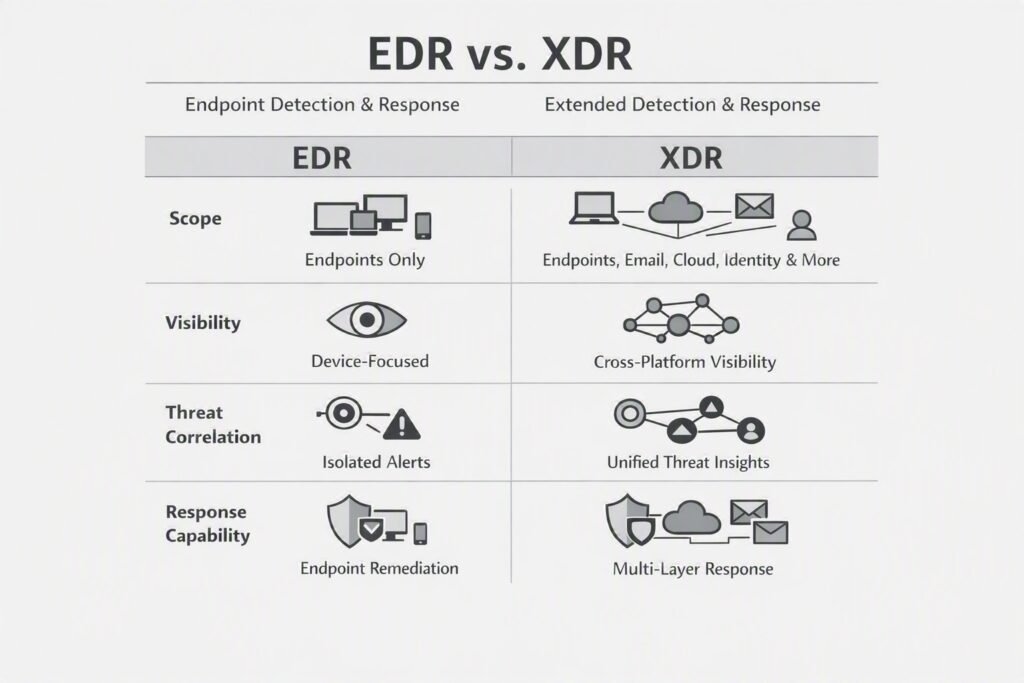
The Simple Analogy
Think of EDR as a high-definition security camera focused on your front door.
Think of XDR as an intelligent surveillance system covering the entire property, connecting data from cameras, motion sensors, access controls, and security guards into one dashboard.
Both are valuable. XDR simply provides broader context.
Why Endpoint Detection and Response (EDR/XDR) Matters More Than Ever
The cybersecurity landscape has fundamentally changed.
Attackers no longer rely solely on malware files that can be easily detected. Modern threats increasingly involve:
- Fileless attacks
- Credential theft
- Living-off-the-land techniques
- Cloud account compromise
- Identity-based attacks
- Multi-stage ransomware campaigns
A phishing email may compromise a user account, which later accesses a cloud application and eventually reaches critical systems. An endpoint-only view may miss that broader attack chain.
XDR was designed specifically to address this challenge through cross-domain visibility. Microsoft notes that modern attacks frequently start at one layer and move into others, making unified detection increasingly important.
Architectural Shifts Transforming Threat Detection
If you look past standard vendor positioning, the practical reality of deploying these modern security architectures highlights three major shifts that are changing how defense teams operate:
1. The Maturity of Agentic AI and Autonomous Investigation
For years, automated response meant relying on rigid, pre-configured playbooks. If event A occurred, the system executed action B. Today, top-tier platforms are shifting toward advanced agentic AI architectures capable of independent reasoning and contextual planning.
When a suspicious event is flagged, these AI agents gather telemetry, query external global threat intelligence databases, analyze user intent, and execute precise remediation steps without requiring an analyst to manually review the case. This drastic reduction in manual triage frees up security teams to focus on proactive threat hunting rather than chasing repetitive alerts.
2. Identity as the Primary Security Battleground
Protecting the operating system kernel remains critical, but credential theft has quickly become the path of least resistance for modern threat actors. Because of this trend, modern detection frameworks are aggressively prioritizing Identity Threat Detection and Response (ITDR) integrations. By linking behavioral endpoint telemetry to active user access profiles, the security ecosystem can instantly flag when a standard developer’s device suddenly attempts to request privileged administrative access to a production customer database.
3. The Open vs. Native Ecosystem Dilemma
Organizations face a significant structural decision when upgrading their detection frameworks. Native platforms bundle the entire security stack from a single provider, offering smooth out-of-the-box correlation but introducing the long-term risk of vendor lock-in.
Conversely, open architectural frameworks act as an independent, vendor-agnostic correlation layer that interfaces with your existing security tools via robust API integrations. Balancing these approaches requires an honest assessment of your current infrastructure investments, team size, and integration capabilities.
How a Modern EDR/XDR Workflow Works
Step 1: Continuous Monitoring
The platform continuously collects telemetry from endpoints and other connected systems.
Step 2: Behavioral Analysis
Machine learning and behavioral analytics identify suspicious activity patterns.
Step 3: Alert Correlation
Related events are connected into meaningful incidents.
Instead of generating dozens of separate alerts, the system may identify a single coordinated attack.
Step 4: Investigation
Security analysts review:
- Attack timelines
- User activities
- Device behavior
- Lateral movement patterns
Step 5: Response
The platform can automatically:
- Isolate endpoints
- Disable compromised accounts
- Block malicious IP addresses
- Stop suspicious processes
Step 6: Recovery
Teams remediate systems and use forensic insights to strengthen defenses against future attacks.
Real-World Scenarios Where EDR/XDR Excels
Ransomware Detection
Modern ransomware attacks typically involve multiple stages:
- Initial access
- Credential theft
- Lateral movement
- Data exfiltration
- Encryption
EDR helps identify suspicious endpoint behavior during these stages, while XDR provides visibility into related identity, cloud, and email activity.
Insider Threat Detection
Not all threats originate externally.
Unusual access patterns, privilege misuse, and unauthorized data movement can be detected through behavioral analytics and cross-platform correlation.
Compromised Accounts
A stolen credential may appear legitimate in isolation.
However, when correlated with unusual device activity, impossible travel patterns, or abnormal cloud access, XDR can expose the compromise much faster.
Supply Chain Attacks
Sophisticated attacks increasingly exploit trusted vendors and software providers.
Cross-environment monitoring helps detect unusual behavior even when it originates from seemingly authorized sources.
Conclusion
The future of cybersecurity is not just about preventing attacks—it’s about detecting, understanding, and responding to them quickly.
Endpoint Detection and Response (EDR/XDR) represents a major shift from reactive security toward intelligent, data-driven defense. EDR provides deep visibility into endpoints, while XDR expands that visibility across identities, cloud services, email systems, and networks to uncover threats that would otherwise remain hidden.
Perhaps the most important lesson is this: security teams no longer suffer from a lack of data. They suffer from a lack of context. XDR addresses that challenge by connecting the dots across the entire attack surface.
As cyber threats continue to evolve, organizations that invest in visibility, rapid detection, and coordinated response will be far better positioned to defend their business, customers, and reputation.
Pingback: Roadmap to the Cybersecurity world - The Cyber Server