Imagine your organization’s data as water in a complex, pressurized plumbing system. For years, our strategy was simple: cap the obvious leaks. We blocked USB ports, monitored email attachments, and patted ourselves on the back. There was no focus on the DLP Channels and Theories, resulting in poor strategy and management, leading to historic data leak events.
But today, in 2026, that plumbing system has changed. It’s no longer a closed loop. It connects to an ocean of cloud applications, infinite API integrations, and helpful AI assistants that voraciously consume information. The old methods of “plugging holes” don’t work when the entire infrastructure is designed to be porous.
To effectively protect data today, we need to move beyond configuring tools and start examining the underlying philosophies of governance. We need to interrogate our core theories about DLP channels.
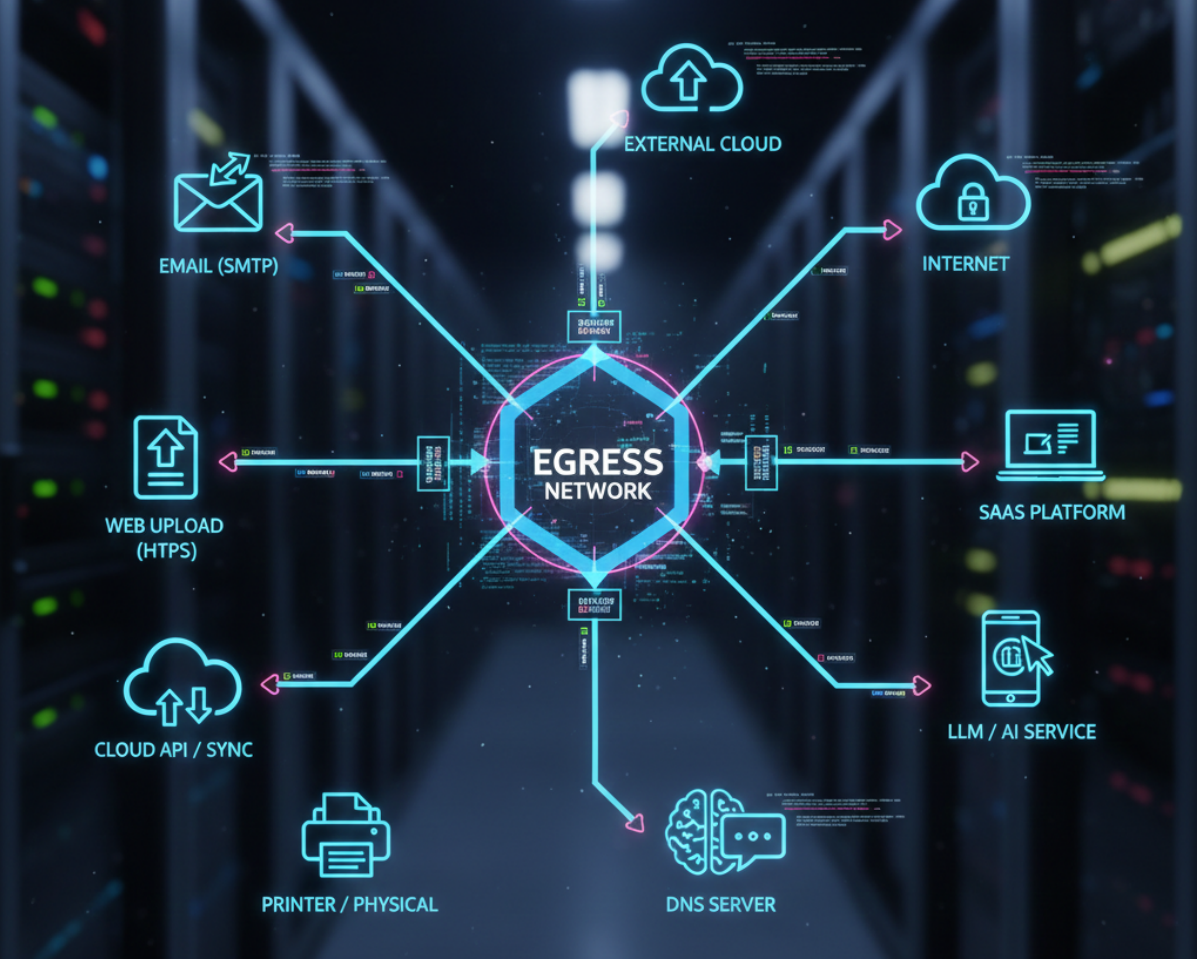
A “channel” is no longer just a physical port or a network protocol. It is any pathway—technical, psychological, or accidental—through which data transitions from a trusted state to an untrusted one. Understanding the theories behind these pathways is the difference between a security posture that frustrates employees and one that actually secures the business.
The Evolution of Egress Thinking
Historically, Data Loss Prevention (DLP) theory was predicated on the “Castle and Moat” concept. The theory assumed that all sensitive data lived inside the perimeter, and all channels leading out (the drawbridges) could be manned by guards.
This theory collapsed with the advent of cloud computing and remote work. The perimeter dissolved. Today, data doesn’t just “leave”; it lives simultaneously in multiple states across various platforms.
Modern theories about DLP channels must accept a messy reality: data must flow to be valuable. Our job isn’t to stop the flow, but to ensure it flows only through authorized, monitored, and secure conduits. We have moved from a theory of “prevention via blocking” to “protection via contextual understanding.”
Core DLP Theories Governing Modern DLP Channels
If we strip away the vendor marketing, we find three prevailing theories that dictate how organizations currently manage data channels. Understanding which theory your organization subscribes to—consciously or unconsciously—is vital.
1. The “Hydraulic” Theory (The Path of Least Resistance)
This is perhaps the most human-centric theory. It posits that data flow behaves like water: it will always find the path of least resistance.
If your sanctioned channels are high-friction—for example, if sending a large, legitimate file via corporate email is difficult due to draconian size limits—users will not simply give up. They will find a lower-friction channel. They will use personal WeTransfer accounts, a random Dropbox folder, or slip the data onto a generic USB drive.
The Insight: When you lock down a visible channel without providing a viable alternative, you don’t stop the data flow; you just push it underground into Shadow IT. A successful DLP strategy doesn’t just block high-risk channels; it actively clears the path for low-risk, sanctioned channels.
2. The “Choke Point” vs. The “Mesh” Theory
This is an architectural debate. The classic theory relies on Choke Points. You force all traffic—web, email, FTP—through a central gateway (like an on-premise proxy) where inspection happens. This provides centralized control but creates performance bottlenecks and fails when users are off-network.
The modern counter-theory is the Mesh approach, often realized through Secure Access Service Edge (SASE) architectures. In this theory, the inspection engine is decoupled from a physical location and moves to the cloud edge. Every user connection, whether they are in a Starbucks or headquarters, goes through a micro-inspection point in the cloud.
The Insight: In 2026, the Mesh theory is winning. The idea that you can backhaul all global traffic to a single choke point for DLP inspection is obsolete. The channel is wherever the user is, so the inspection must be there too.
3. The “Contextual Integrity” Theory
Old DLP theories were binary: “Does this file contain a credit card number? Yes = Block.”
The Contextual Integrity theory argues that a channel cannot be judged solely by the data passing through it. The risk is defined by the context of the transfer.
- Scenario A: An HR manager uploading a spreadsheet of salary data to the corporate Workday portal via HTTPS.
- Scenario B: A software engineer uploading the same spreadsheet to Pastebin via HTTPS.
The data is identical. The protocol (channel) is identical. But under Contextual Integrity theory, Scenario A is business-as-usual, and Scenario B is a critical incident.
The Insight: Effective channel monitoring requires interconnecting identity (who), endpoint posture (which device), destination (where), and data sensitivity (what). Theories that ignore context will drown security teams in false positives.
The New Frontier: The “Generative” Channel
We cannot discuss modern theories about DLP channels without addressing the elephant in the room: Generative AI.
Tools like ChatGPT and corporate LLMs have created a fundamentally new type of channel. It is not just a transfer mechanism; it is a Transformation Engine.
When a user pastes proprietary code into an LLM prompt to ask for debugging help, the data hasn’t just left the building; it has potentially been absorbed into a third party’s training model. The egress channel is the prompt window.
Traditional theories struggle here. How do you regex match data that has been summarized, rephrased, or translated by an AI? The theory here is shifting toward intent analysis and browser isolation, treating the AI input field as a high-risk, untrusted zone by default.
Comparing Theoretical Approaches – DLP Channels and Theories
| Feature | Traditional “Castle” Theory | Modern “Contextual Mesh” Theory |
| Primary Perimeter | The Corporate Network Firewall | Identity and Data itself |
| Channel Focus | Physical ports, Email, Web Gateway | Cloud APIs, SaaS sharing, GenAI prompts |
| Inspection Method | Centralized Choke Points | Distributed Edge / SASE Mesh |
| Policy Logic | Binary (Allow/Block based on regex) | Contextual (Who, What, Where, Why) |
| User Impact | High Friction (Blocks legitimate work) | Lower Friction (Coaching and nudges) |
Key Insights for Security Leaders
Refining your organization’s theories about DLP channels requires a shift in perspective.
- Stop treating all channels equally. A USB drive in 2026 is rarely used for legitimate business; treat it with extreme suspicion. A cloud storage API is essential for business; treat it with nuanced monitoring.
- Embrace the “Audit first, Block later” philosophy. When turning on monitoring for a new channel (like AI), run in audit mode for weeks. Understand the “hydraulic flow” of legitimate business before you introduce friction.
- Map channels to business processes, not tech. Don’t have a “Web DLP Policy.” Have a “Financial Reporting Egress Policy” that dictates which channels finance teams can use during quarterly close cycles.
- Leverage User Entity and Behavior Analytics (UEBA). Since encryption often blinds us to the content within a channel, we must rely on the behavior surrounding the channel. Why is this user uploading 5GB of encrypted data at 3 AM on a Saturday?
Conclusion
The technology we use to monitor data will continue to evolve rapidly, but the underlying theories about DLP channels change much slower. Are you still operating on a theory of centralized control in a decentralized world? Are you ignoring the “hydraulic pressure” of your users’ need for efficiency?
By moving beyond simple tool configuration and interrogating the theoretical frameworks governing your data egress, you can build a DLP strategy that is resilient, adaptive, and ready for whatever new channels the future holds.