If you’ve worked in IT for more than a week, you know the feeling. A user calls saying they can’t log in. Then another. Then fifty more. The blood drains from your face because you know it’s not the Wi-Fi; it’s something far more fundamental. It’s the central nervous system of your entire infrastructure seizing up. It’s Active Directory.
For over 25 years, Microsoft Active Directory (AD) has been the undisputed heavyweight champion of identity management. When cloud computing began its meteoric rise a decade ago, many tech evangelists gleefully predicted the death of on-premises AD.
They were wrong.
In 2026, Active Directory hasn’t retired; it has adapted. While the cloud is booming, AD remains the deeply entrenched “source of truth” for the vast majority of enterprises globally. Understanding its modern role isn’t just about nostalgia—it’s a critical survival skill for any IT or cybersecurity professional operating in today’s hybrid reality.
Beyond the Phonebook: What AD Really Is Today
In the early 2000s, we often explained AD as a “digital phonebook” for users and computers. While technically true, that analogy woefully undersells its current importance.
Today, think of Active Directory as the passport control, customs agency, and law enforcement of your on-premises network combined. It doesn’t just list who you are; it cryptographically proves it (authentication) and dictates exactly what you are allowed to touch (authorization).
Through Group Policy Objects (GPOs), it enforces configuration standards across thousands of servers and workstations instantly. If you need to disable USB ports on 5,000 machines by 9 AM tomorrow, AD is the only way to fly. It is the mechanism that turns a chaotic collection of hardware into a manageable fleet.
The Great Confusion: Active Directory vs. Entra ID (Azure AD)
This is where I see the most confusion among newcomers and even seasoned devs shifting to ops. Microsoft’s rebranding of Azure AD to Microsoft Entra ID helped clarify things slightly, but the misconception persists that one replaces the other.
Let’s be crystal clear: In most enterprise environments in 2026, they are partners, not competitors.
On-premises Active Directory was built for a world within a firewall, relying on protocols like Kerberos and NTLM. Entra ID was built for the wild west of the internet, using modern web-based protocols like SAML, OAuth 2.0, and OpenID Connect to manage access to SaaS apps like Office 365 or Salesforce.
Comparison: The Tale of Two Directories
| Feature | On-Premises Active Directory (AD DS) | Microsoft Entra ID (formerly Azure AD) |
| Primary Habitat | Your data center (behind the firewall). | The Cloud (Microsoft’s data centers). |
| Language It Speaks | LDAP, Kerberos, NTLM. | REST APIs, SAML, OAuth, OIDC. |
| Primary Job | Managing servers, workstations, GPOs, and legacy apps. | Managing SaaS access, MFA, and external identities. |
| Structure | Hierarchical (Forests, Domains, OUs). | Flat structure (Tenants). |
In a typical hybrid setup, your on-prem AD is usually the “master” database. A tool like Microsoft Entra Connect syncs those identities up to the cloud. When you change a password on your office PC, AD changes it locally and tells the cloud to update it, too.
Key Insights: The “Identity as Perimeter” Paradigm Shift
The biggest shift between Active Directory in 2010 and 2026 is security. Fifteen years ago, we protected AD by building bigger firewalls around the network. Today, the network perimeter has dissolved. Identity is the new security perimeter.
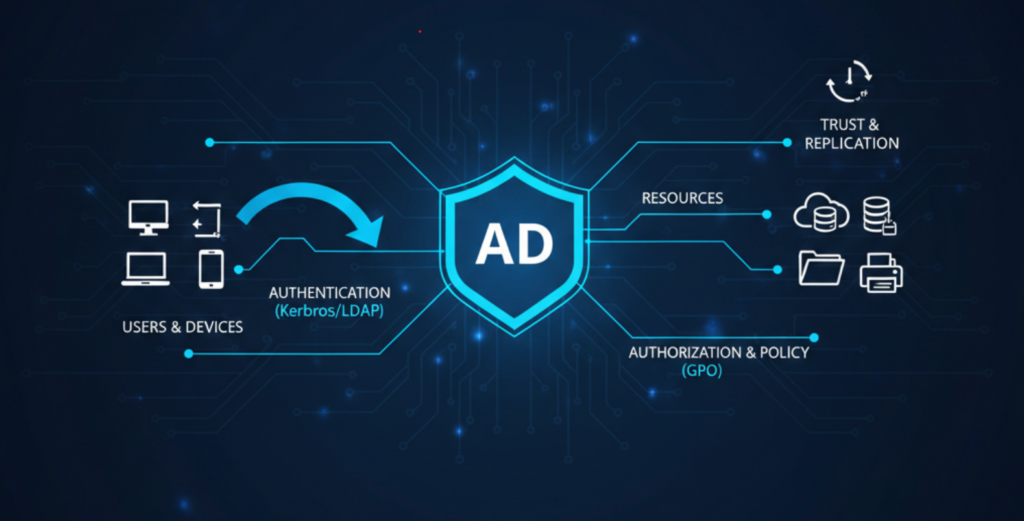
Because AD holds the “keys to the kingdom,” it has become the number one target for sophisticated attackers.
1. The Target on AD’s Back is Massive
If an attacker compromises a standard user account via phishing, they have a foothold. But their ultimate goal is almost always “domain dominance.” They want to escalate privileges until they control a Domain Admin account.
Once they have that, they own everything. They can deploy ransomware via GPO to every single machine simultaneously. They can create “Golden Tickets”—forged Kerberos authentication tokens that give them indefinite, undetectable access to any service.
In 2026, protecting AD is less about managing users and more about rigorous cybersecurity hygiene. If you aren’t actively hunting for paths to privilege escalation within your AD environment, you are already compromised.
2. The Tiering Model is No Longer Optional
In my experience auditing environments, the most common flaw is a “flat” administrative structure. A Domain Admin should never log into a regular workstation to check email. If that workstation is compromised, their credentials can be scraped from memory.
Modern AD management requires a strict Tiering Model:
- Tier 0: Domain Controllers and highly privileged accounts. These are guarded like Fort Knox.
- Tier 1: Application servers and databases.
- Tier 2: User workstations and devices.
Admins should have separate accounts for different tiers, and accounts from a higher tier should never log into a lower tier machine. It’s painful to implement, but essential for survival.
3. The Threat of “Technical Debt” GPOs
Active Directory is often old. I’ve seen domains that have been upgraded continuously since Windows Server 2003. These environments are littered with the ghosts of admins past—Group Policies created 15 years ago for software that no longer exists, or security settings that are now actively dangerous.
This “GPO sprawl” slows down login times and creates bizarre conflicts. More importantly, it often hides security vulnerabilities. A regular audit and cleanup of your GPO infrastructure isn’t just housekeeping; it’s a security necessity.
Conclusion: Respect the Old Guard
It’s tempting to chase the newest, shiniest cloud identity platforms. And yes, for a brand-new startup born in the cloud today, you might never need on-premises Active Directory.
But for the vast majority of organizations with established infrastructure, servers in racks, and legacy applications that generate revenue, Active Directory remains the bedrock.
In 2026, being an AD expert means understanding hybrid identity. It means knowing how to secure Kerberos while simultaneously managing conditional access policies in the cloud. AD isn’t dying, but the skillset required to manage it has become significantly harder and more critical. Respect the old guard, secure it relentlessly, and it will keep your digital world turning.